
FOI, GIPA and RTI volumes keep climbing and redaction absorbs most of the effort. What AI genuinely helps with, what it must not decide, and the controls that make output defensible.
Information access teams across Australian government are dealing with a volume problem that headcount cannot solve. FOI, GIPA and RTI request numbers keep climbing, the material attached to each request keeps growing, and the statutory clocks have not moved. Redaction is where most of the time goes.
Why manual redaction does not scale
A single request can produce thousands of pages spread across email threads, scanned attachments, case files and increasingly body worn video or call recordings. An officer has to read all of it, identify every piece of exempt material, apply the correct exemption, and do so consistently across documents that repeat the same names hundreds of times.
The failure mode is not usually a missed deadline. It is inconsistency. The same individual is redacted on page 40 and left visible on page 380 because a different officer handled that batch on a different day. That inconsistency is what turns into a complaint, a review, and occasionally a disclosure incident.
What AI can actually do here
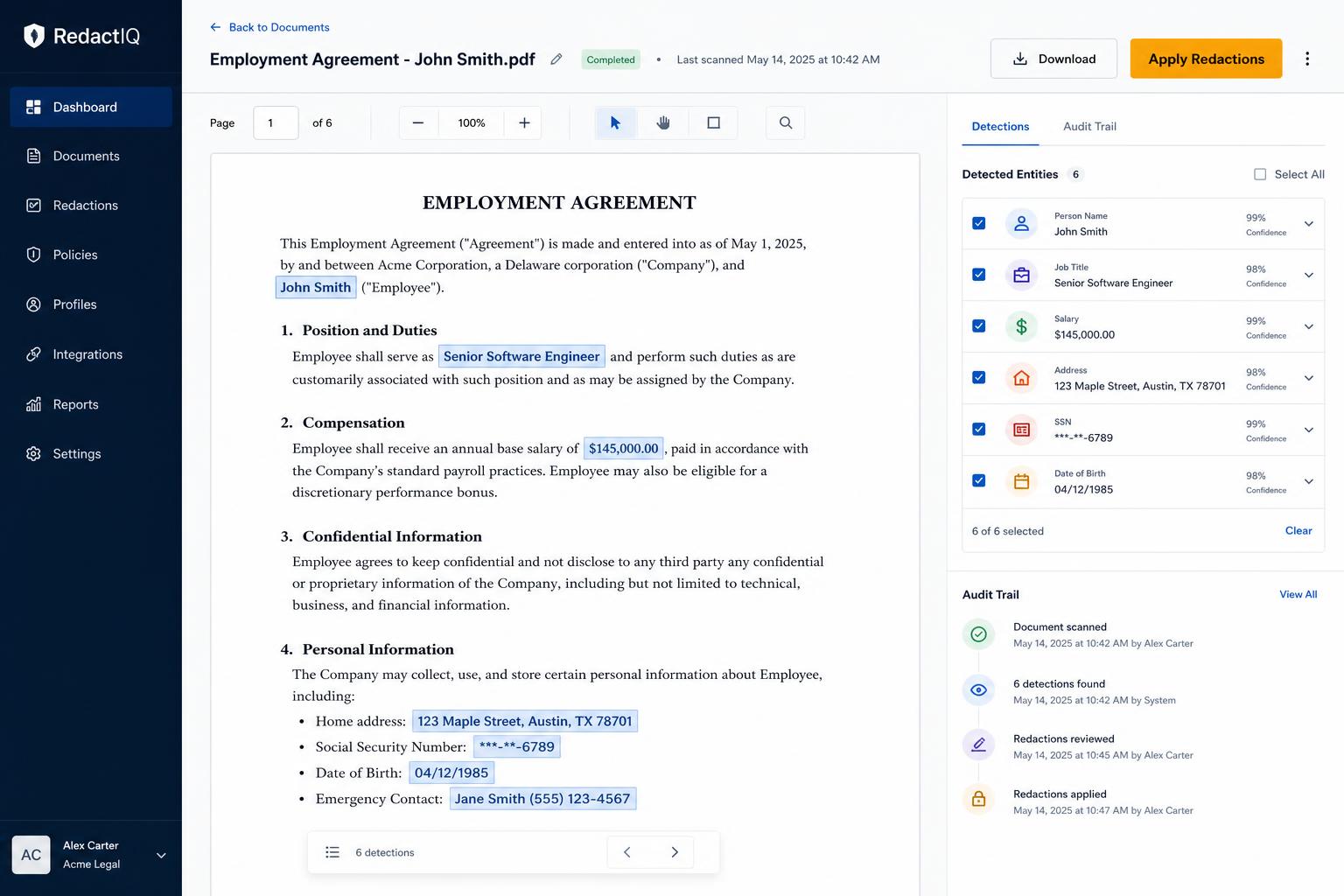
AI is good at the mechanical layer. It can detect entities such as names, addresses, phone numbers, dates of birth and identifiers with high recall across large volumes. Crucially, it can apply a decision consistently: once an officer decides that a particular individual is exempt, the system can propose that redaction everywhere that individual appears, including across variant spellings and in scanned material via OCR.
That is the real gain. Not replacing judgement, but making a single act of judgement propagate reliably across ten thousand pages.
What it cannot do
AI cannot decide whether an exemption applies. Public interest tests, deliberative process considerations and legal professional privilege all require a human to weigh context and be accountable for the outcome. Any vendor implying otherwise is describing a product that will not survive its first review.
It also cannot be trusted blind on recall. Detection models miss things, particularly unusual name formats, handwritten annotations and information that is identifying only in context. The design has to assume misses and build review around them.
Human in the loop, done properly
Human in the loop is often used to mean a person clicked approve. That is not a control. A meaningful design gives the officer the proposed redactions with the reason and confidence attached, surfaces low confidence detections for explicit attention rather than burying them, and makes accepting or rejecting each proposal a recorded act attributable to a named person.
Evidence grade output
Two technical requirements are non negotiable in this domain. Redactions must be destructive in the released artefact, meaning the underlying text is removed rather than covered with a black rectangle that can be copied out or lifted in a PDF editor. And every action must be logged: what was proposed, what was accepted, by whom, when, and under which exemption. If a release is later challenged, that log is the defence.
Where to start
Take a closed request that has already been processed manually and run it through as a parallel exercise. Compare what the system proposed against what the officers did. That gives you a genuine recall and precision measure on your own material, in your own document formats, rather than a vendor benchmark on someone else's corpus. It also tends to surface the inconsistencies in the manual baseline, which is uncomfortable and useful in equal measure.
We build these controls into Seers Redact, and apply them across our delivery in justice and policing.